



Free delivery on orders over £100 equivalent
Couldn't load pickup availability
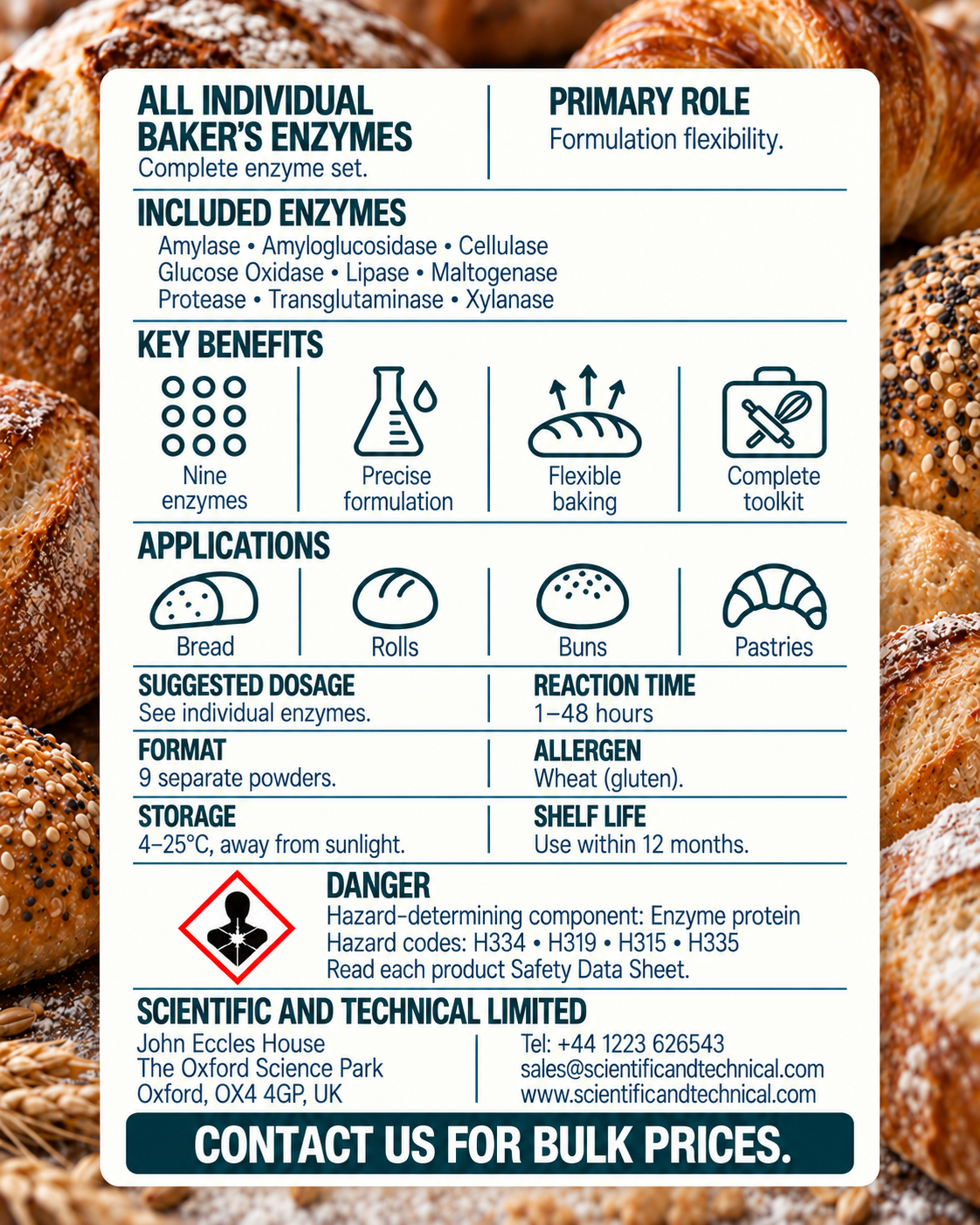
All Baker's Individual Enzymes (9 in total): Includes: Baker's Amylase, Amyloglucosidase, Cellulase, Glucose Oxidase, Lipase, Maltogenase, Protease, Transglutaminase, Xylanase
Instructions: Various, see individual enzymes for details.
Ingredients: Various, see individual enzymes for details.
Pack size: Various, each enzyme individually packed, the g shown represents the collective amount of enzyme supplied.
Storage: Store at 4–25°C away from sunlight. Use within 12 months.
Cellulase scientific deep dive
Explore cellulase EC numbers, molecular properties, reaction mechanisms, natural sources and industrial applications, with an interactive protein structure and scientific references.


Supporting technical guides

Baking formulation
Choosing Bread Improver Enzymes: Blend or Individual Components?
Choose a bread enzyme blend or individual components using flour performance, controlled bake trials and product quality targets.
Read technical guide
Enzyme science · Deep dive
Enzyme blends: structure, mechanism and industrial uses
Formulated blends combine selected activities to address multiple bonds or sequential reaction steps in food, cleaning and biomass processes.
Read technical guide
Enzyme science · Deep dive
Alpha-amylase: structure, mechanism and industrial uses
Rapid internal chain cleavage makes starch slurries easier to pump and prepares them for brewing, glucose production, cereal drinks and removal of starch-based stains.
Read technical guide
Enzyme science · Deep dive
Glucoamylase: structure, mechanism and industrial uses
Conversion of liquefied starch into glucose supports fermentation feedstocks, glucose syrups and alcohol production.
Read technical guide
Enzyme science · Deep dive
Glucose oxidase: structure, mechanism and industrial uses
The same chemistry supports glucose measurement, oxygen removal and controlled oxidative modification in food and materials processing.
Read technical guide
Enzyme science · Deep dive
Lipase: structure, mechanism and industrial uses
Hydrolysis produces fatty acids, while controlled low-water reactions enable ester synthesis, interesterification and biodiesel-related conversions.
Read technical guide
Enzyme science · Deep dive
Maltogenic amylase: structure, mechanism and industrial uses
Controlled starch modification can slow bread crumb firming during storage, linking molecular changes in starch to a measurable improvement in texture.
Read technical guide
Enzyme science · Deep dive
Protease: structure, mechanism and industrial uses
They turn protein-rich feedstocks into peptides with different solubility, flavour and functional properties, and break down protein soils during cleaning.
Read technical guide
Enzyme science · Deep dive
Transglutaminase: structure, mechanism and industrial uses
Crosslinking can strengthen protein gels, improve binding and alter the texture of dairy, meat and plant-protein foods.
Read technical guide
Enzyme science · Deep dive
Xylanase: structure, mechanism and industrial uses
Cleaving the xylan backbone supports cereal processing, dough modification, pulp treatment and access to fermentable biomass carbohydrates.
Read technical guide