



Free delivery on orders over £100 equivalent
Couldn't load pickup availability
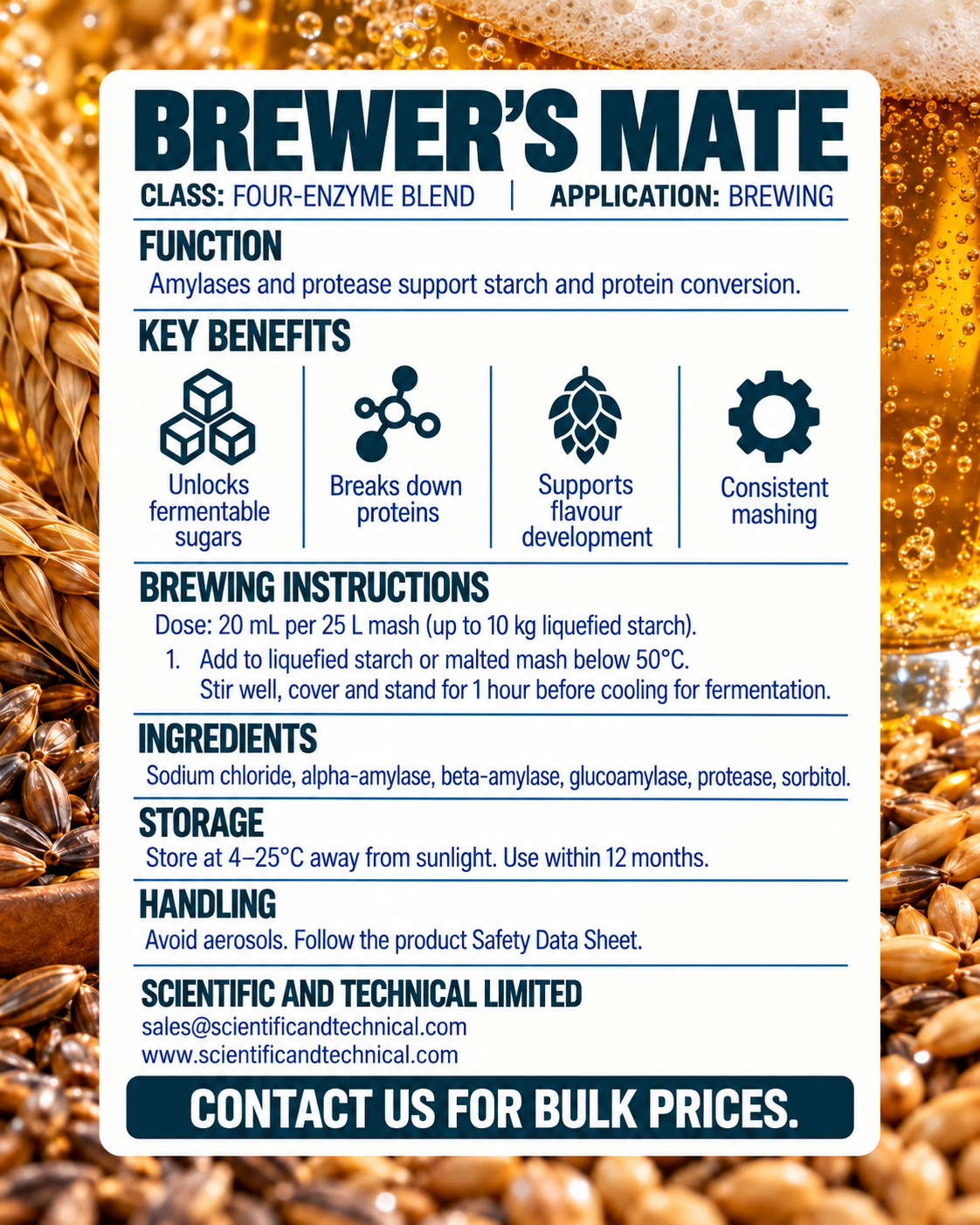
Brewer’s Mate: High activity alpha-amylase, beta-amylase, glucoamylase and protease to maximise full flavour profiles and yields for brewing and distilling.
Key benefits: Helps removes protein and gluten, reduces mashing time to minutes, unlock higher sugar content, unlocks full flavour profiles, consistent mashing and reduces haze. Compatible with adjuncts. 100% CMO-free.
Instructions: 20 mL Brewer’s Mate (2x lid full) per 25 L mash (up to 10 kg of liquefied starch).
Add Brewer’s Mate to liquefied starch or malted mash below 50°C. Stir well then cover, allow to stand for 1 hour before cooling for fermentation.
Ingredients: Sodium chloride, alpha-amylase, beta-amylase, glucoamylase and protease, sorbitol.
Storage: Store at 4–25°C away from sunlight. Use within 12 months.


Supporting technical guides

Starch and fermentation
Xylanase for Cereal Mash Filtration: When Is It Useful?
Evaluate xylanase for cereal mash viscosity and filtration. Separate arabinoxylan effects from starch, beta-glucan and mechanical limitations.
Read technical guide
Enzyme science · Deep dive
Enzyme blends: structure, mechanism and industrial uses
Formulated blends combine selected activities to address multiple bonds or sequential reaction steps in food, cleaning and biomass processes.
Read technical guide
Enzyme science · Deep dive
Alpha-amylase: structure, mechanism and industrial uses
Rapid internal chain cleavage makes starch slurries easier to pump and prepares them for brewing, glucose production, cereal drinks and removal of starch-based stains.
Read technical guide
Enzyme science · Deep dive
Beta-amylase: structure, mechanism and industrial uses
Successive release of maltose supports maltose-rich syrups and brewing, with the branch structure of the starch controlling how far conversion proceeds.
Read technical guide
Enzyme science · Deep dive
Glucoamylase: structure, mechanism and industrial uses
Conversion of liquefied starch into glucose supports fermentation feedstocks, glucose syrups and alcohol production.
Read technical guide
Enzyme science · Deep dive
Protease: structure, mechanism and industrial uses
They turn protein-rich feedstocks into peptides with different solubility, flavour and functional properties, and break down protein soils during cleaning.
Read technical guide