



Free delivery on orders over £100 equivalent
Couldn't load pickup availability
Lipase (eco detergent): High activity lipase for digesting fats and oils.
Applications: include: Cleaning, Washing, Fabrics & Textures.
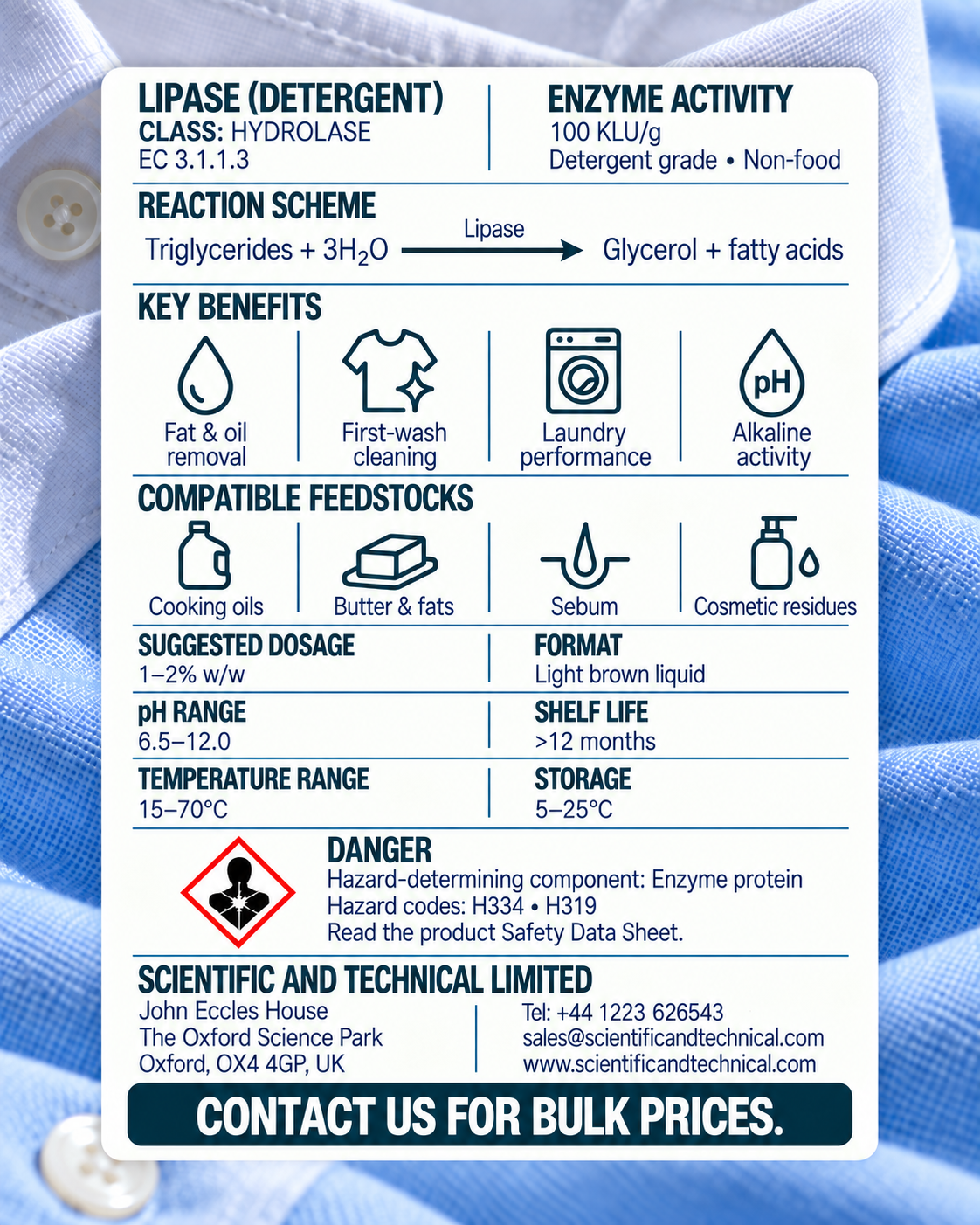
Properties: Our lipase is an alkaline liquid lipase for use in biological detergent products. The product acts by hydrolysing insoluble fat & oil soilings such as those resulting from frying fats, salad oil, butter, gravy, soup, human sebum and cosmetics. This enzyme hydrolyses fats by cleaving the ester bonds of triglyceride molecules producing mono and di-glycerides, glycerol and free fatty acids which can then be readily removed from fabrics. This enzyme is particularly effective at first wash removal of fatty stains in laundry applications. The enzyme is derived from a genetically modified strain of Aspergillus spp. The activity is expressed in Kilo Lipase Units (KLU), and contains no significant side-activities.
Reaction:
Triglycerides (fats & oils) → Glycerol + Free Fatty Acids
- Activity: 100 KLU / g *
- Certification: Detergent (non-food grade).
- Appearance & density: Light brown liquid, 1.2 g/mL
- Total Protein: 5–10 % v/v
- Temperature range: 15–70°C
- pH range: 6.5–12.0
- Substrates: Fats & oils
- Products: Glycerol + Free Fatty Acids
- Typical product dosage: 1–2% w/w
- Shelf Life & Storage: >12 months (see file for more information)
* where 1 U is the amount of enzyme required to release 1 μmol of fatty acid from olive oil under standard conditions
Application guides


Supporting technical guides

Cleaning
Which Enzymes Do I Need for a Detergent Formulation?
Match protease, amylase, lipase and mannanase to cleaning targets, then test compatibility and storage stability in your detergent formulation.
Read technical guide
Cleaning
Lipase for Grease Removal: Choosing and Testing a Cleaning Enzyme
Evaluate detergent lipase for fatty soils with controlled wash tests. Learn which grease types to check and how formulation affects the result.
Read technical guide
Enzyme science · Deep dive
Lipase: structure, mechanism and industrial uses
Hydrolysis produces fatty acids, while controlled low-water reactions enable ester synthesis, interesterification and biodiesel-related conversions.
Read technical guide